Category: EDCI339 (Page 1 of 2)

Final Submission: Group Free Inquiry Project

At the beginning of the term, we were assigned a group inquiry project. We settled on our topic of How does social media affect attention span, focus, productivity, and learning in digital environments? Our project looks at all aspects of the topic, not just whether it is helpful or harmful. We got multiple perspectives through research and personal experiences.

Over the last 4 weeks, we investigated current research on social media use, attention spans, and types of digital distractions. We all collaborated on research for our topic, but then personally conducted our own experiments on our screen time, social media habits, and more…

Our final project was finalized through a website where we brought together all of our findings and made it one cohesive project. You can find everything through the link below and  how we were able to broaden our understanding on the very complex relationship between social media, learning, and attention in the digital world of today.

https://sites.google.com/view/edci339inquiry-project?usp=sharing 

Week 4 Reflection (For Grading)

Figure 1. Feedback image 

In our course work this week, we had a look at how teacher effective assigned grades to students. The reading we were assigned gave perspective on this as well as our class.  The first thing that I thought about was the concept of how learning itself directly can’t really be measured. The learning cant really be physically observed, but how instructors and educators can make inferences about what students know based off how their work get completed or produced. To me, this is a given, but I didn’t really ever think that much about how much interpretation is involved when assigning a grade to a project. While a student could fully understand the material can experience things like stress, time pressures, lack of sleep, and make a mistake. On the opposite side of the spectrum, students might not fully understand the work but are able to get a correct answer. Vygotsky’s writing from 1978 is a contradiction to this and how grades are an accurate reflection of the learning student have.

A discussion I keep thinking about was the margins of error when it comes to grading. Guskey and Brookhart (2019) agreed that th emesuraments of grading are not allows accurate or precise and can commonly have significant margins of error.   The discussion about margins of error in grading was also interesting. Guskey and Brookhart (2019) argue that grades are not precise measurements of learning and often contain a significant margin of error. The idea that many have gone over the things we talked b auto in class was how grades can fall within an average, which can have negative consequences to students needing to keep a percentage average to keep school funding, to stay in a program, or even to keep a personal goal or standard. It was a good feeling when I learned through this that receiving a 84% vs an 86% on an assignment or even a final grade doesn’t really properly represent an important different and that they are sometimes more like an estimate than and exact measurement.

One of the other concepts that stuck with me was the feedback students get. A piece from Hattie and Timperley (2007), and looked at effective feedback, finding that it helps learners understand what stage they are in their learning, where they could make some improvements, and where their writing could be with the effective feedback. Another thing that I could relate this to would be  my experience as a Swimming lesson instructors and how I give evaluating and feed back to my students and their guardians. In my training and 6 years on experience in the field, I have been able to adopt ways to make sure my students from ages 2 years old all the way to 90 years are understanding where they are doing amazing and where they can improve. When talking about these areas, I use the Sandwich Method. This is where you start with positive feedback, move to an area that can improve on, then back to nothing they excelled at. This not only boosts confidence in themselves but is a way to keep a positive relationship with the water and me, especially if I have a student who is older than me, where the power dynamic is flipped.


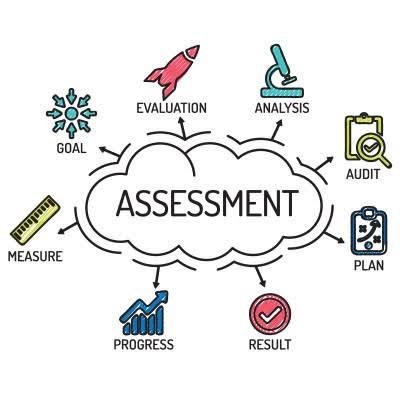
Figure 2. Assessment infographic  image 


Carless (2019) introduces another idea, being “feedback spirals”. This is where feedback cant be looked at as a one time thing but as something that is for learners to build on over time (Carless, 2019). I that the feedback I get from my instructors can be a little, but also can be a lot. Sometimes when the feedback is more or something that will benefit but requires me to think extra, it won’t be fixed overnight, but it is something I continue to work on going forward. Looking back at my own experiences in this, I can confirm that when an instructor has taken the time to fully evaluate my work and give me good quality feedback, I have been able to make improvement that therefore help with work in the course but also in my classes moving forward. Good feedback can go way beyond just a comment on an assignment it can improve the quality in the long run.

Another connection I learned about was technology and assessment. Bower (2019) argued that tech can work like a mediator for learning as opposed to the direct result of learning outcomes. Honestly, I think I see a resemblance to how this can apply to assessment. Technology has been able to provide individuals with so many opportunities within assessment, and some of the ones I have experience in my schooling would be online quizzes, discussion spaces, digital portfolios for an art class, and even this course. One of the main things that I can think about is when I took ASL at UVIC. The course would not have been possible at the student capacity it did  if it weren’t for the videos assignment, online learning tools, and video zoom calls. I was in such an engaging and interesting course, and my grades and assessments were possible because of technology.

I am a firm believer that assessment should not simply be a way of ranking students or giving them a percentage. While I don’t know a way to make that possible or a program to execute that,  all I can hope is that myself, my future teachers, instructors, and managers all have a common goal of wanting their students or employees to succeed and are will to give effective feedback all to support learning and growth that can help well into my future (Hattie & Timperley, 2007).  I really enjoyed this week, and it helped me feel a little bit better about when I get a grade I’m not super happy with, because it could be 2% more.


References:

Biggs, John. 1996. “Enhancing Teaching Through Constructive Alignment.” Higher Education 32 (3): 347–64. https://doi.org/10/chx3gp.

Bower, Matt. 2019. “Technology-Mediated Learning Theory.” British Journal of Educational Technology 50 (3): 1035–48. https://doi.org/10.1111/bjet.12771.

Guskey, Thomas R., and Susan M. Brookhart, eds. 2019. What We Know about Grading: What Works, What Doesn’t, and What’s Next. ASCD.

Swimming Lesson Guide – Giving feedback

Vygotsky, Lev S. 1978. Mind in Society. Edited by Michael Cole, Vera John-Steiner, Sylvia Scribner, and Ellen Souberman. Translated by Alexander Romanovich Luria. Harvard University Press.

Figures:

(1): Chase, C. (2020, January 20). What happens during an IT assessment? Directive Technology, Inc. https://www.directive.com/blog/what-happens-during-an-it-assessment.html

(2): Magnific. (n.d.). Positive feedback images [Image collection]. Magnific. https://www.magnific.com/free-photos-vectors/positive-feedback

Week 3 Reflection Post

This week, we got the opportunity to view a lecture by Dr. Valerie Irvine from 2025. This lecture focused on how education is no longer simple and face-to-face vs online learning, it is becoming almost more flexible, and with the come the development of different modalities aiding students and learners with all different abilities (Irvine, 2025). My thought process before the lecture was that online learning was a convenience. I am a busy person who works 2 jobs and is taking three summer classes, and the flexibility my online summer courses have given me are extremely helpful in being able to continue with everything I have on the go.

Dr Irvine spoke about good examples of how modality for students can be confusing. She mentioned how a slight change in language, such as the phrase “flexible,” helped join the formats of onsite and online learning sound more positive, but didn’t give a student a solid answer as to how they were going to be completing the program. (Irvine, 2025). This can be especially helpful for students living in rural communities, who have ongoing health concerns or who need to prioritise other responsibilities like work to support themselves or a family. This highlighted for me how important clear communication is, especially when institutions are advertising and designing courses.

Then, thinking about the different learner groups we touched on, the one that comes to mind is students who are balancing school and work. As a university student, almost everyone I know is working a part-time, if not full-time, job to keep themselves financially afloat. Pack schedules make it hard to come to class, especially if it is a shift change or even a last-minute responsibility that is unavoidable. Dr. Irvine’s research, which she spoke about, looked into how students preferred online or flexible options because it allowed them the grace in finishing their education without sacrificing certain areas of life.

As someone who is diagnosed with ADHD, I am someone for whom asynchronous online learning doesn’t really work the best. I tend to need face-to-face interaction, a motivation to go to class, or to feel like I am absorbing the content accurately. I assumed that there was going to be a preference on both sides of the learning types. The results showed that face-to-face learning was the most popular, and a significant number of students preferred Multi-access, hybrid, or online options.  In this week’s coursework, what stood out to me the most was the different groups and how different their preferences were. For example, caregivers and rural learners often preferred online learning. While international students liked face-to-face learning more. This solidifies Dr. Irvine’s point that there is no modality that works for everyone.

One of the other resources we were asked to look at was the B.C. Post-Secondary Digital Learning Strategy. This site emphasized how important increasing access and flexibility in education is.  One of the main goals is to try to create learning opportunities where they are available, regardless of a student’s location or the unique obstacles they are facing. Modality plays such a major role in getting to that goal. Breaking technology barriers, such as in making sure students have access to devices to work off of, is not enough. Institutions need to look at course offerings and intentionally decide delivery modes to fit all students needs.

While I only have one more year at UVIC, other students in the future are going to need more than what we have currently. Educational delivery will need to continue to advance to more flexible & accommodating learning. That is why I think prioritising all delivery modes, not just face-to-face, can be beneficial. While I’m not saying things need to move to one or the other, I would love to see students feel supported in the way they get their education and have more of a choice.

One of the final things that stuck with me for this week was a comment Dr. Irvine made it and it was that “ anytime you choose a mode, you marginalize a learner”. Its simple sentences explain a complex system. Rather than deciding if face-to-face or online is better, why don’t we try and create education spaces that include as many students as possible?


References:

AEST – Irvine – Veletsianos – Digital Learning Framework.pdf 

Dr. Valerie Irvine (2025), EDCI339

https://www2.gov.bc.ca/gov/content/education-training/post-secondary-education/institution-resources-administration/digital-learning-strategy


Process Post # 4

This is the final week of the course and myself and my group members will be wrapping this up, getting things organized and proof reading and ready for submission. We will have the two dedicated sections to our research and our personal learning and mini evaluating on our own research we did. As a learning pod we got together and delegated tasks dividing the work load and making sure everything was the best it could be. 

Looking back on this project there were some really interesting and exciting aspects but also some things that made it difficult personally in my experience. I had a hard time finding resources when it came to certain things I wanted to cover. Social media is not an ancient system and really hasn’t been around for use to fully find resources to back our inquiry topic. I also struggled with trying to make things perfect and not being able to have everything go as planned. While this is not something that anyone can control I didn’t do my best to set myself up to succeed. 

This course has been eye opening. This is my first EDCI course and has opened up a new avenue of learning that I don’t think I will stop continuing my learning on. This course has made me more aware of the privacy and security of the internet, the ideas of multi model learning, and with this project how we can create something really cool and have a low criteria passion project come to life. 


Process Post # 3

For this week’s process post and project work I wanted to shift my focus from distraction to educational opportunity on social media. While last week my group members and I looked into research I wanted to look at more research on the negative effects of social media on attention spans. 

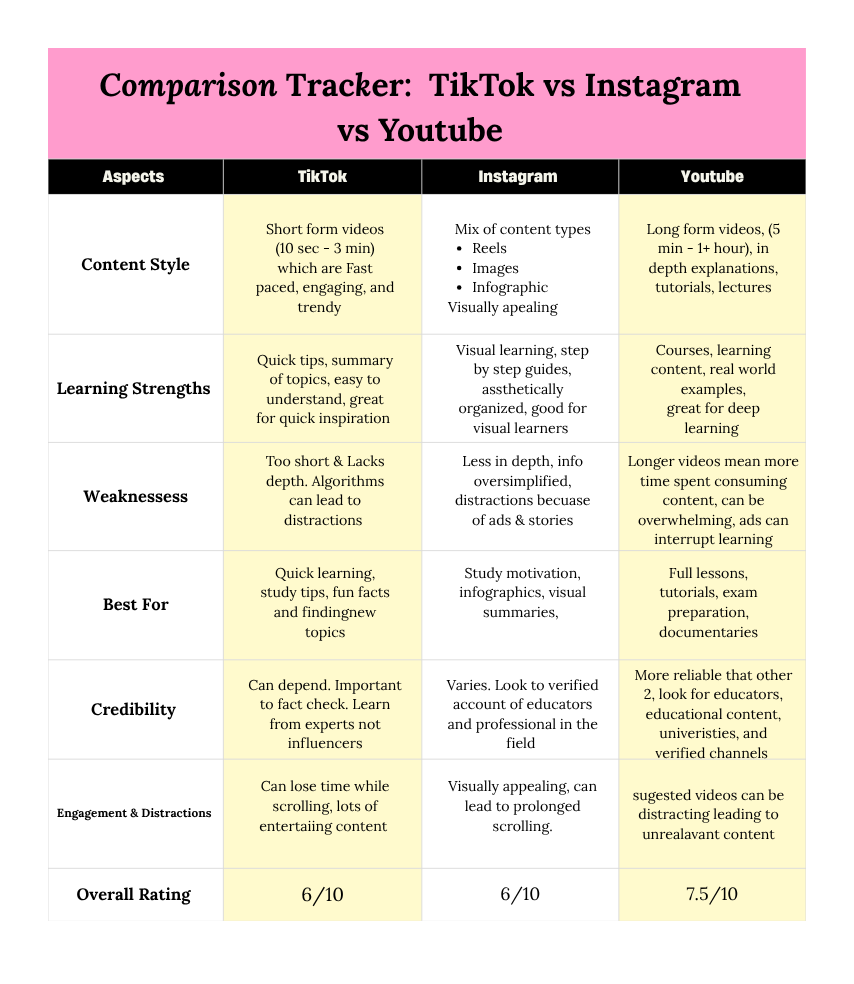
Throughout the week I intentionally followed and engaged with educational content on social media instead of aimlessly scrolling. I viewed these creators and content on TikTok, Instagram and Youtube. I look for creators who share knowledge and information on education, sciences, Law, marketing, personal development and some news accounts. One of the creators I found I enjoyed watching was Kayla Lee. Kayla Lee goes by @kaylaleelawyer on tiktok and works as a Lawyer who specializes in DUI and traffic offenses. She has extensive information and resources on ICBC and the rules and laws of the road. I have been able to keep up to date with changes to our learners permits in BC and then to fact check her information I looked into the ICBC website and viewed those changes she had mentioned. I was also consistently avoiding the short form videos and looking for longer, more in depth content in and giving thought to whether the short form videos were helping me learn new information.      

One thing that makes the short-form videos or content I normally gravitate towards useful for is introducing new topics quickly. This aligns with research on microlearning, which suggests that small pieces of information can support learning and encourage further exploration of a topic (Buchem & Hamelmann, 2010). A one minute video is more just the spark notes of the subject and can sometimes not provide all the information I need on content. It feels like it can be over simplifying the content I am engaging with. It makes me think about how much meaningful learning I am getting when I am only viewing the shorter form videos.

One of the things I did when this was a concern was fact checking the information when I feel like I didn’t get enough details. I looked into peer reviewed articles and reliable sources. Research by Wineburg and McGrew (2019) highlights the importance of fact-checking and evaluating the credibility of online information, especially when learning through digital platforms. When doing this I found that most of the information was accurate and well supported, but in some cases important details were missing or even over exaggerated. This is highlighting the importance of critical thinking when using social media as a learning tool.

Another thing I was more aware of is the fact that scrolling on platforms like Instagram or TikTok, the topic of content I am watching changes every 30-60 seconds. While Greenhow and Lewin (2016) suggest that social media can support informal learning and knowledge sharing, I found that constantly changing topics sometimes made it difficult to retain information.Even though I learned small things here and there, I struggled to remember details later when thinking back to using screen time. This made me think that a journal entry could be a good way to track this.

Another interesting finding was how quickly I moved from one topic to another while scrolling. Even educational content encouraged rapid consumption of information. Although I learned small pieces of information, I sometimes struggled to remember details later because I had consumed so much content in a short amount of time.


In our group project we will showcase all of our work on a website where one section is dedicated to the research we have gathered and the other section will be about our personal experiments and experiences with altering and reflecting on our social media use. 


References 

Buchem, I., & Hamelmann, H. (2010). Microlearning: A strategy for ongoing professional development.

Greenhow, C., & Lewin, C. (2016). Social media and education: reconceptualizing the boundaries of formal and informal learning. Learning, Media and Technology, 41(1), 6–30. https://doi.org/10.1080/17439884.2015.1064954 

@kylaleelawyer

Snelson, C. (2011). YouTube across the disciplines: A review of the literature. MERLOT Journal of Online Learning and Teaching, 7(1), 159–169.

Wineburg, S., & McGrew, S. (2019). Lateral Reading and the Nature of Expertise: Reading Less and Learning More When Evaluating Digital Information. Teachers College Record (1970), 121(11), Article 110302. https://doi.org/10.1177/016146811912101102


Process Post # 2

To start this week I wanted to get to know more about digital distractions and how social media can impact my attention span. While last week we started researching these topics I wanted to test them myself and be more conscious about my own habits.

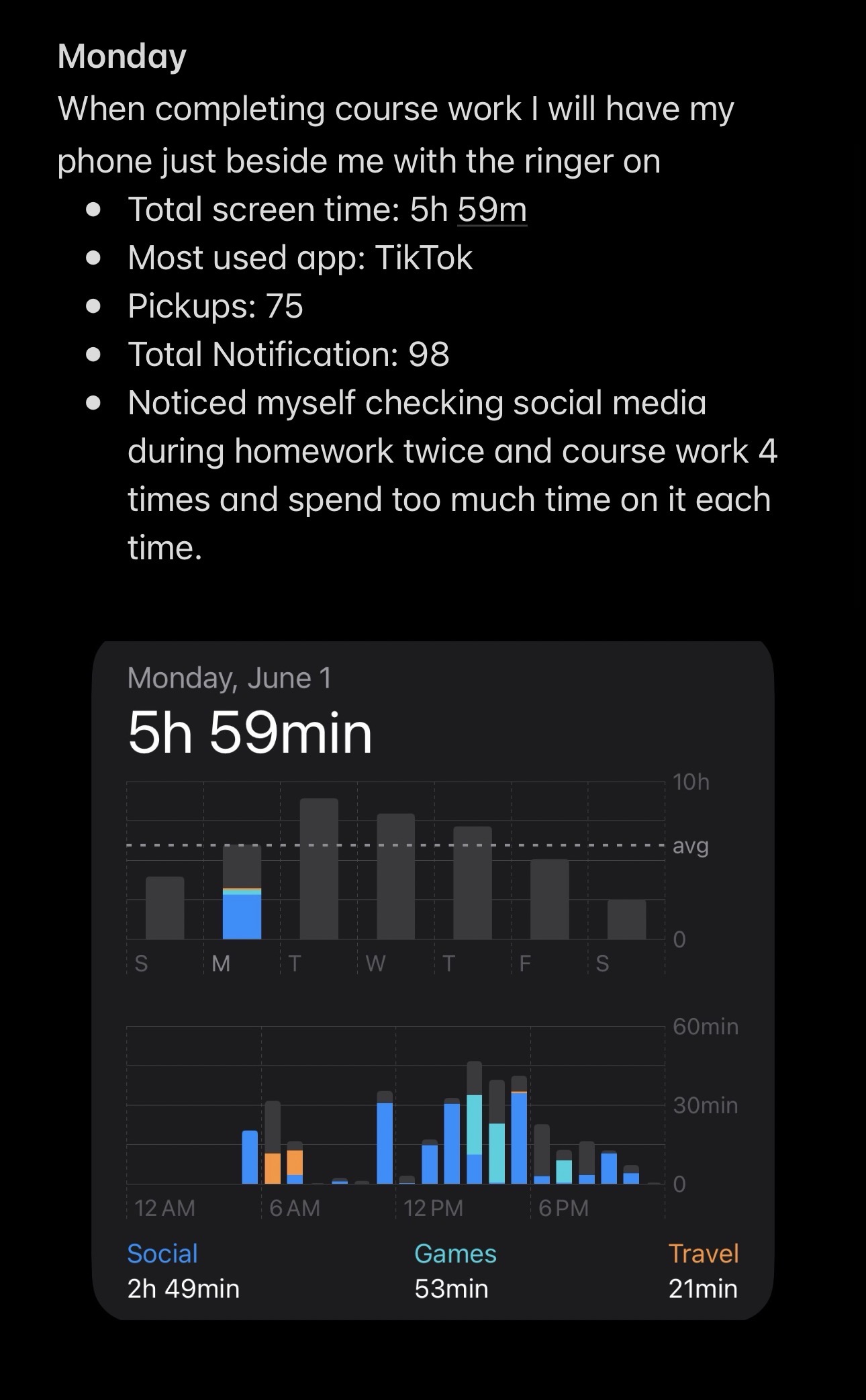
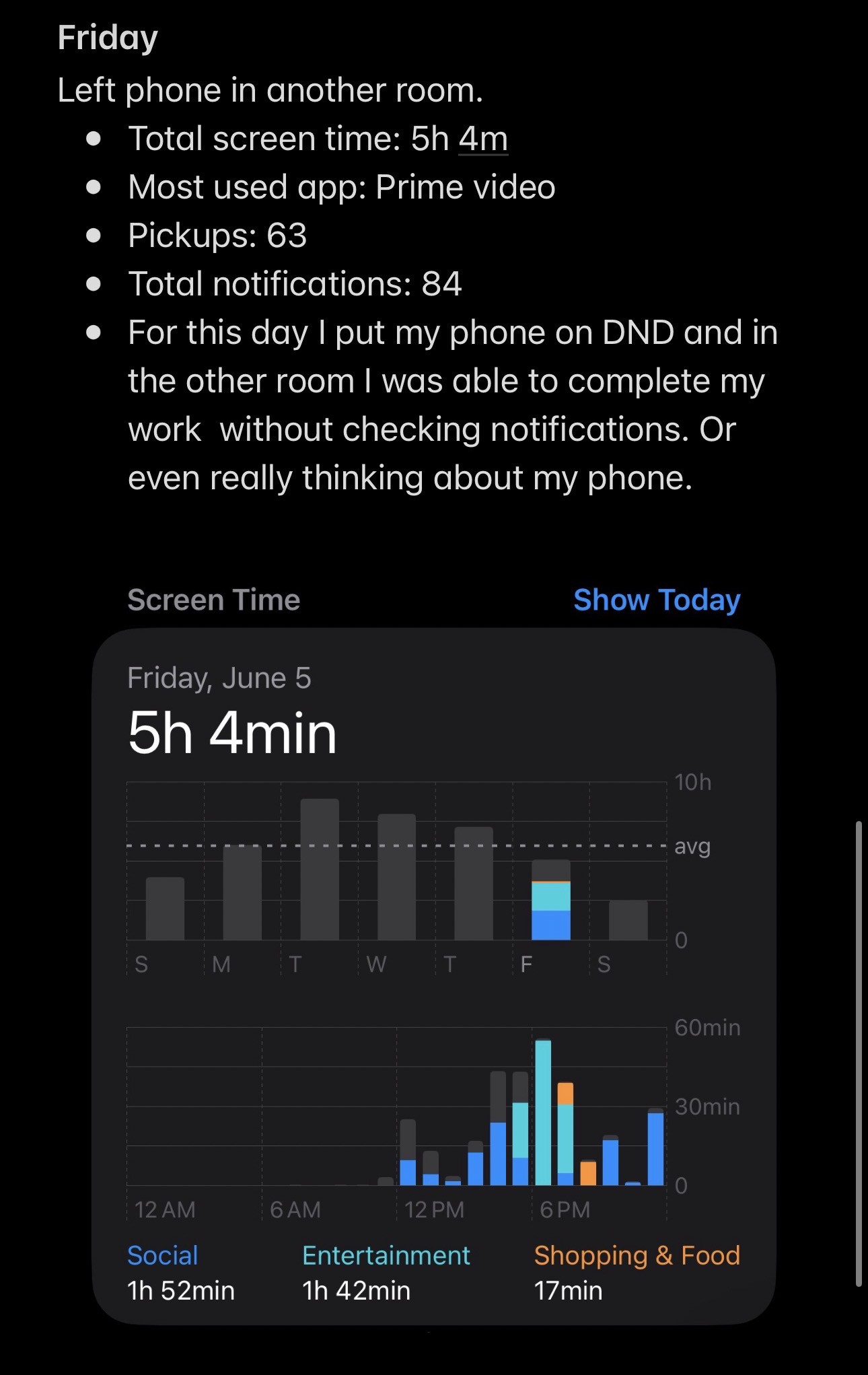
To get a better sense of my own habits I utilised my phone apps such as Apple’s Screen Time feature to track my usage of my phone for the week. I kept a mindful eye on my screen time throughout the week and the apps u used most. One thing that I learned is that not only does it track my screen time, it also tracks how many times I picked up my phone and what app I opened as soon as my phone was picked up, as well as the notifications and how many each app gave me that week.    

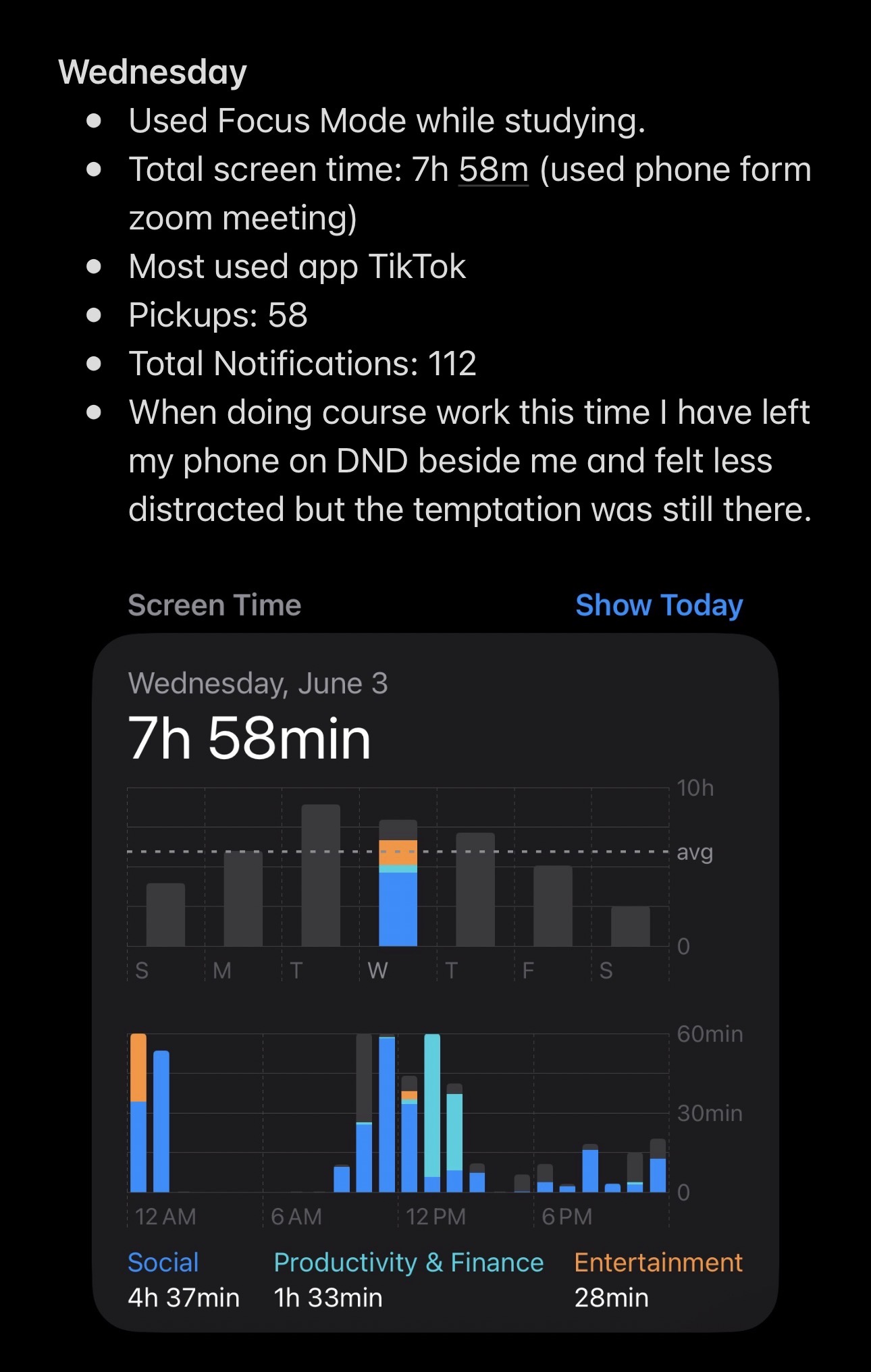
As part of my inquiry I tested different working conditions when completing our course work. During my phone I kept my phone beside me with my ringer on and other times I would work while my phone was in another room with a focus or Do not Disturb (DND) mode on. I noticed when my phone was out of sight I was able to focus more and felt less tempted to take a break and scroll. This was similar to research I looked at by Stothart, Mitchum, and Yehnert (2015), who found even getting or seeing a notification pop up on your screen can reduce a person’s attention and negatively impact how the task is completed. Even though I tried to be super strict with myself when doing the work, just knowing my phone was within reaching distance made it harder to concentrate on my work. 

One thing I really struggle with is completing tasks due to having ADHD. When my phone is close to me I realized I was constantly switching between my course work, texts, social media and other apps. When I put my DND on and in the other room I found it easier to focus. This reminded me of a reading I did from Gazzaley and Rosen’s (2016) discussion from The Distracted Mind, and how they explained that our brains are not supposed to or are designed to constantly multitask. Their research shows that frequent notification interruptions reduce concentration and productivity. Another study I also took a look at for this week was by Rosen, Carrier, and Cheever (2013), who found that students that switch between studying and social media and that social media use was most used were associated with lower academic performance.   


This week I kept track using a journal entry system as well as a weekly review  which you can see below. 

Screenshot

Screenshot


Screenshot

Weekly Review Entry

Category  Reflection 
Weekly Screen Time 41h and 37m 
Top 3 Most Used Apps TikTok -> Instagram -> zoom 
Educational Topics Viewed  BC road laws, sciences, history, and news
New Things Learned ICBC Corporation bylaws
Fact Checked  Yes / no 
Focus Rating  8/10
Productivity Rating 8/10
Biggest Distraction  Phone or environment when I did course work 
Main take away(s)  Need to prioritize putting the devices on DND and away from my reach to keep me productive. 


Resources 


Gazzaley, A., & Rosen, L. D. (2016). The distracted mind : ancient brains in a high-tech world. The MIT Press.


Rosen, L. D., Mark Carrier, L., & Cheever, N. A. (2013). Facebook and texting made me do it: Media-induced task-switching while studying. Computers in Human Behavior, 29(3), 948–958. https://doi.org/10.1016/j.chb.2012.12.001 


Stothart, C., Mitchum, A., & Yehnert, C. (2015). The Attentional Cost of Receiving a Cell Phone Notification. Journal of Experimental Psychology. Human Perception and Performance, 41(4), 893–897. https://doi.org/10.1037/xhp0000100


Group Assignment 2

Here is our group Assignment 2. 

Our topic was on “The effects on learning due to the COVID -19 pandemic”. We made this assignment a podcast style and split our work by the four main focus questions on. our project was broken down by:

  • What is your distributed and open inquiry question? 
  • What is the relationship of your topic to teaching and learning?
  • What are the pros, cons, and risks?   
  • What are some of the strategies, best practices, and tips regarding your inquiry findings?    

In our podcast, I am the 2nd speaker completing the 2nd question from the list above

I looked at research that could help explain our topic an the shift between in-person to online/remote learning.

Sources

Source from my part:

Koh, J. H. L., & Daniel, B. K. (2022). Shifting online during COVID-19: A systematic review of teaching and learning strategies and their outcomes. International Journal of Educational Technology in Higher Education, 19(1), Article 56. https://doi.org/10.1186/s41239-022-00361-7


Sources other sources from project:

J. Broadbent, W.L. Poon, Self-regulated learning strategies & academic achievement in online higher education learning environments: A systematic review, The Internet and Higher Education, Volume 27, 2015, Pages 1-13, ISSN 1096-7516, https://doi.org/10.1016/j.iheduc.2015.04.007

Koh, J. H. L., & Daniel, B. K. (2022). Shifting online during COVID-19: A systematic review of teaching and learning strategies and their outcomes. International Journal of Educational Technology in Higher Education, 19(1), Article 56. https://doi.org/10.1186/s41239-022-00361-7

Madland, C., & Irvine, V. (2026, June 10). Week 5 [Zoom lecture]. EDCI 339,  University of Victoria.


Process post #1

For our inquiry project, our learning pod is working on understanding the impact of social media on our attention spans. How does social media usage affect productivity, focus, and learning in digital environments? 

For my first process post I will be diving into research, consulting course content that could be applicable and reflecting on our own social media and online habits. 

At the starting of our inquiry project, our learning pod created a google document where we listed out the tasks to be accomplished and delegated them among the learning pod. 

This week’s tasks included: 

  • Gathering research/stats that discuss the social media use in teenagers and its impacts 
  • Looking into Australia ban on social media usage for teenagers and the impacts of the ban. 
  • Looking through the course content to find research on how social media is used in education and learning

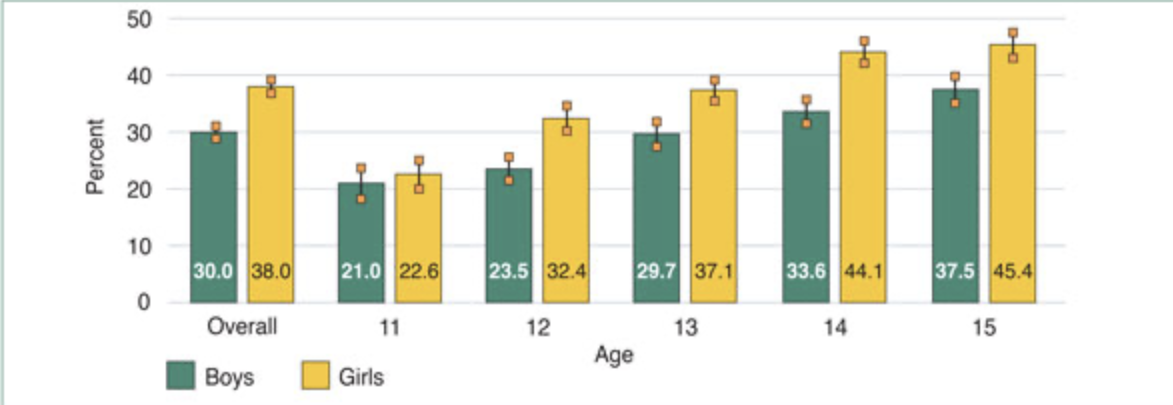
Before I jumped into the research I wanted to get an understanding on social media use in youth. One source I found was by the Public Health Agency of Canada (2022), where they completed a survey of over 17,000 youth that found that 3 in 10 boys and 4 in girls ages 11-15 used social media extensively (seen in figure below). This usage is not just scrolling for hours, but is being used as a tool to connect with classmates, family, and friends.  

Figure 1
Percentage of students who reported extensive social media use by age and gender


   Additional research I looked at was a review completed by Santos et al, (2023) who analyzed 50 articles that looked at potential connections between adolescents mental health impacts and screen time. When observing the data in conclusion they found that prolonged screen use showed greater impact negatively on mental health especially on younger females (Santos et al., 2023). They also touch on how different languages should be adopted, and the term “screen time” does not accurately reflect what their target research is and how that term is broad. There is a major difference between a cell phone for personal use and a computer in an educational context.    

When thinking about the negative effects social media can have, many examples could be used. One of the more relevant topics that comes to mind would be legislation that was put into place in Australia. The Australian government banned social media usage for youth under the age of 16 due to concerns of mental health effects, online hate and potential predator factors (Fardouly, 2025). When we think of all the ways social media is used these can be factors, but what about how we access other content?  Educational content through personal learning and school use websites like Youtube that were a part of a ban. Where even in my personal learning at that age, I was asked to use these websites to view Ted Talks.  An article published by Prendergast and Dyer (2026) talks about this exactly. They looked at how tension can occur when media coverage highlights the ban while simultaneously taking away children’s access to social media and the impacts that could have. They found at the end of their analysis that while the goal of law makers was to protect youth at the same time they are incorrectly generalizing young people and the way they use social media (Pendergast & Dryer, 2026). After this a question I have is maybe banning social media is not as  effective and looking into better strategies could be more beneficial such as teaching youth about internet safety.       

Another aspect of the inquiry includes understanding our social media habits (that we will work collectively as a group): 

  • Stats: average screen time, most common app used, how many time is the phone unlocked 
  • Reflection: When do we tend to use social media, and does that have any significant impacts in our learning (distractions)
  • Future implications: Would limiting social media use have any changes on our ability to learn better (ie. improved attention spans) 

One thing that really stood out to me while researching this topic was, I found it was sometimes difficult to separate the positive and negative impacts of social media. Although many studies focus on concerns about distraction, reduced attention spans, and mental health challenges, social media usage, communication and learning for many young people.

In my personal reflection, social media is used daily, often switching between educational content and entertainment. This has made me curious about whether social media is actually reducing our ability to focus and what kind of content we are absorbing intentionally and unintentionally. We all use social media in personal and educational ways and have a decent ratio of both.

We believe our inquiry connects well with digital learning environments, learner engagement, and self-regulated learning. As we continue our project, I am interested in exploring how learners can balance the benefits of open access to information with the challenges of distraction and maintaining focus. 

Going into next week I will be looking at our own habits and tracking our personal social media use. I am hoping to track this for the remainder of the course to see whether changes to our social media use affect our productivity, concentration and overall learning experience. 


Sources 

Fardouly, J. (2025). Potential effects of the social media age ban in Australia for children younger than 16 years. The Lancet. Digital Health, 7(4), e235–e236. https://doi.org/10.1016/j.landig.2025.01.016


Prendergast, K., & Dyer, E. (2026). Youth social media age restrictions: examining Trans-Tasman media coverage of Australia’s social media ‘ban. Journal of Youth Studies, 1–17. https://doi.org/10.1080/13676261.2026.2626495 


Public Health Agency of Canada. (2022, January 4). Social media use, connections, and relationships in Canadian adolescents: Findings from the 2018 Health Behaviour in School-aged Children (HBSC) study. Government of Canada. https://www.canada.ca/en/public-health/services/publications/science-research-data/social-media-use-connections-relationships-canadian-adolescents.html 

Santos, R. M. S., Mendes, C. G., Sen Bressani, G. Y., de Alcantara Ventura, S., de Almeida Nogueira, Y. J., de Miranda, D. M., & Romano-Silva, M. A. (2023). The associations between screen time and mental health in adolescents: a systematic review. BMC Psychology, 11(1), Article 127. https://doi.org/10.1186/s40359-023-01166-7  

Assignment 1 Proposal: Social Media and Attention Spans

Inquiry Topic

  •  Social Media and Attention Spans: Does social media support learning or reduce focus and productivity?

Inquiry Question: 

  • How does social media affect attention span, focus, productivity, and learning in digital environments?

Purpose of the Inquiry

  • The purpose of this inquiry project is to explore how social media impacts concentration, learning habits, and productivity in online environments. Social media platforms such as TikTok, Instagram, YouTube, and X are increasingly used for communication, entertainment, and educational content. However, these platforms may also contribute to distraction, reduced attention spans, and difficulty maintaining focus.
  • Through this inquiry,  we want to examine both the positive and negative effects of social media on learning and productivity while reflecting on my own digital habits and experiences.
  • This topic connects to distributed and open learning because many learners now use social media as a source of information, collaboration, and educational content.

Learning Plan and Weekly Blog Posts

Week 1: Understanding Social Media and Learning

  • Look online and through course content to find research on how social media is used in education and learning 
  • Looking research or stats on search time preferably in ages 12-18 on social media use and screen time
  • Look into Australia banned social media for children under the age of 16
  • Reflect on my own social media habits and attention span

Week 2: Attention Span and Digital Distraction

  • Look into how prolonged scrolling and notification could affect focus/ concentration
  • Track our personal screentime including distraction
    • Could be documented by screen time app or journaling  
  • Compare study sessions with and without social media access
  • Compare studying or school work with and without phone distractions or social media 
    • This could be by keeping the phone somewhere else 

Week 3: Educational Content on Social Media

  • Engage in and analyze educational creators on our social media platforms: 
    • Tiktok
    • instagram 
    • Youtube   
  • Critically think about based on research from past weeks or our own experiences whether short-form content improves or weakens learning 
  • Look into credibility of the content we are engaging in by fact checking with peer reviewed research: what did we find 

Week 4: Reflection and Final Evaluation

  • Summarize our findings about or inquiry topic and question
  • Reflect on our own experiences and possible changes in productivity and focus the past weeks 
  • Evaluate based off the past weeks if social media is more beneficial or harmful for learning. 
  • Track other factors like sleep, mood and overall feelings and talk about potential changes we would or could make to better ourself and our productivity 

Technologies and Platforms

To document our learning we will:  learning, I plan to use:

  • Post weekly on our wordpress blogs
  • Use apps or a calendar or some sort of planner to track weekly tasks and keep ourselves accountable 
  • Use screen time tracking tools and screen time limits on problematic apps
  • Use educational resources, articles, podcasts, and videos

Multimedia and Open Resources

Each weekly post could include:

  • Reflection and analysis and research based on week above 
  • Screenshots or graphs related to screen time or 
  • Journal entries
  • Mind maps or visuals similar to that
  • Links to articles, videos, podcasts, and educational resources we found helpful

Expected Outcome

By the end of this inquiry project I hope to be able to better understand the effects of social media use and how it plays a role in attention span and focus. Whether that be from research and better educating ourselves or from personal experience and improving in areas because of this assignment.


Reflection # 2

This week in class we took a look at websites that made us more aware of data privacy, digital consent, and the way that our information is tracked when using the internet. 

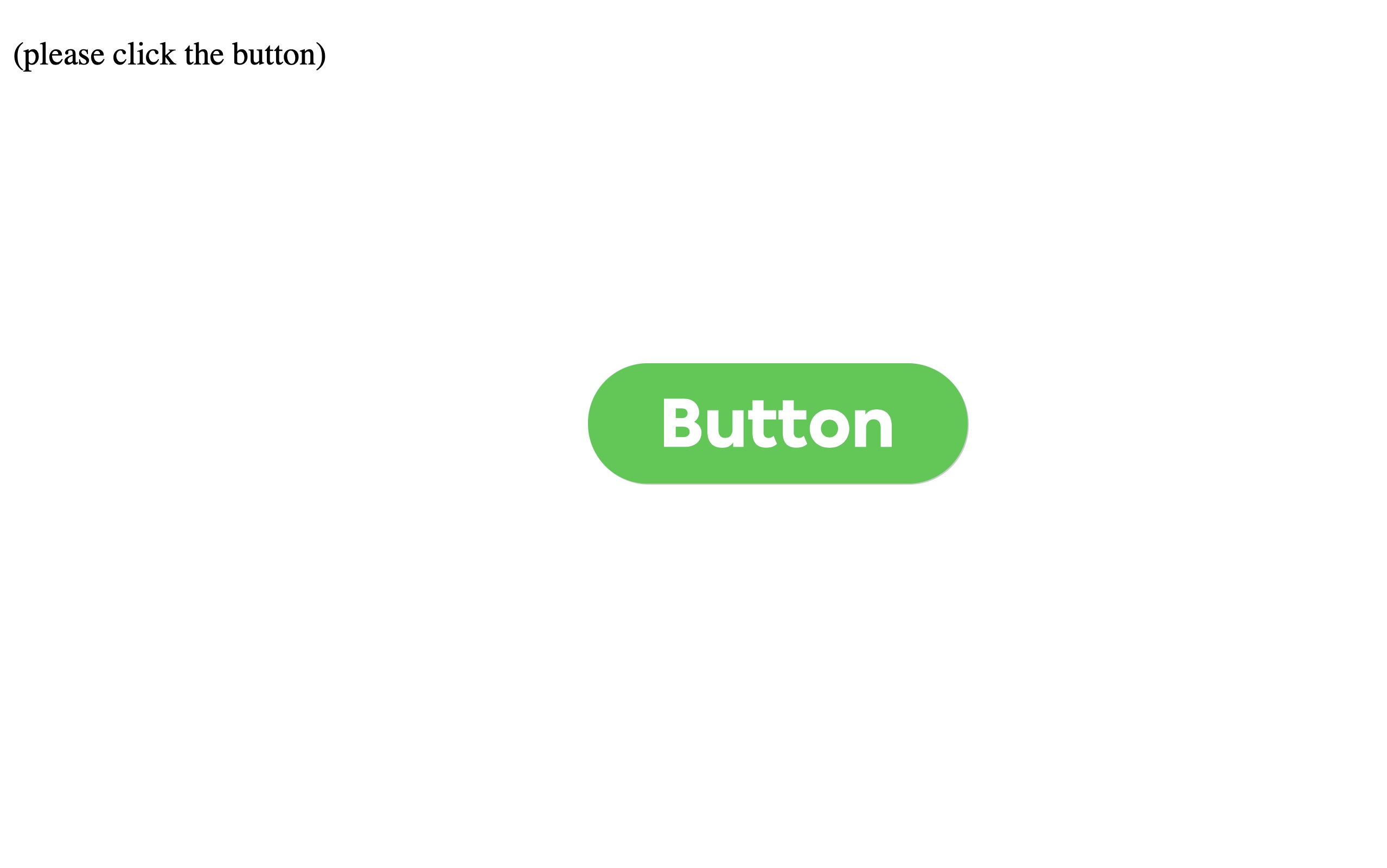
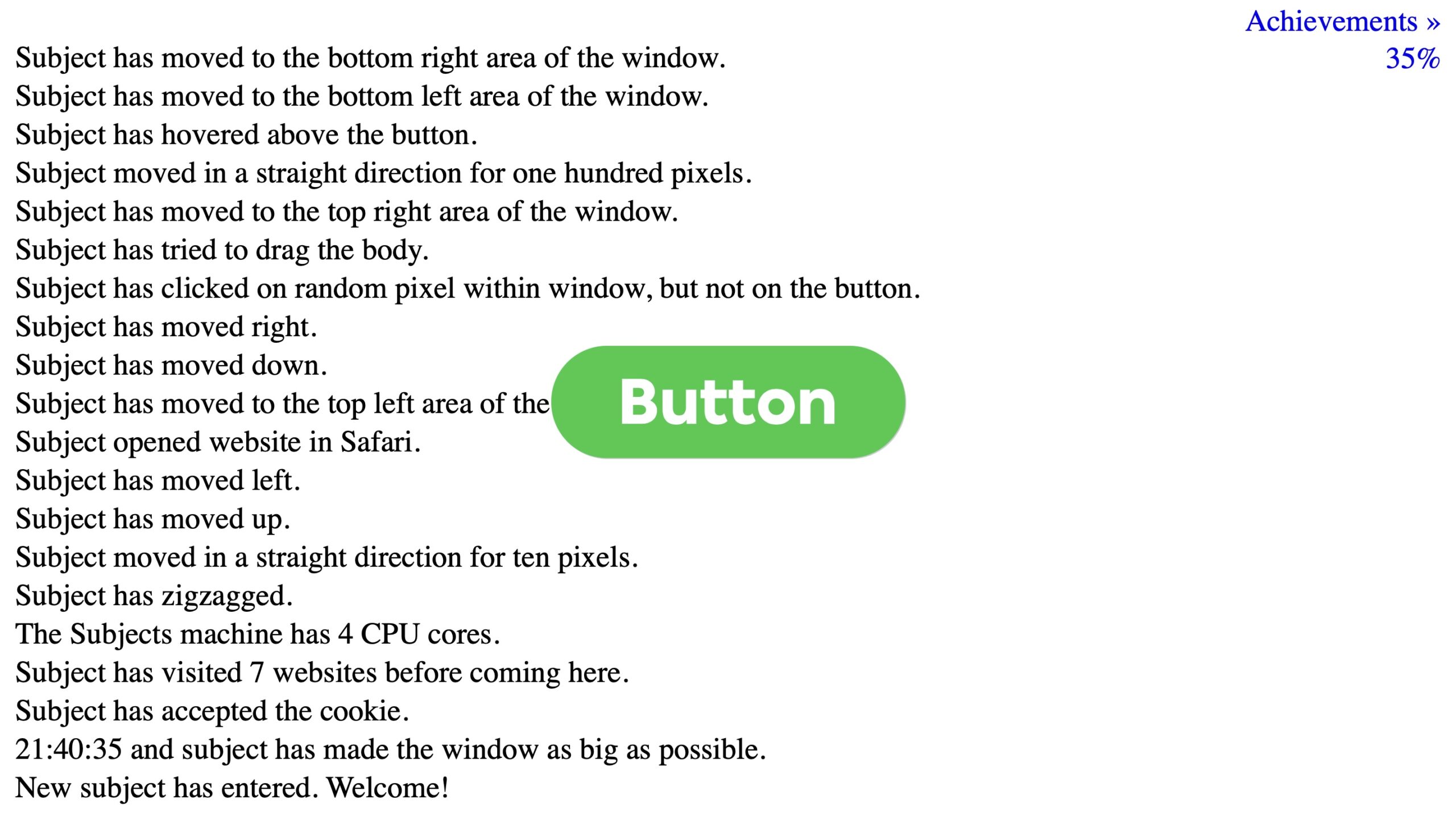
In our class on May 20th we looked at a few websites that I am going to break down into more detail below. One of the first ones we were asked to look at was a website called “clickclickclick.click.” This website is interactive with the motion you do and the things that you click. It can tell where the mouse moves on the track pad and even if you go off the tab will know how long the site was inactive for. In the images below you can see how the website starts off and what it looks like after I have used it, showing the list of things like my mouse movement, inactive status and more. 


  Screenshot

Screenshot

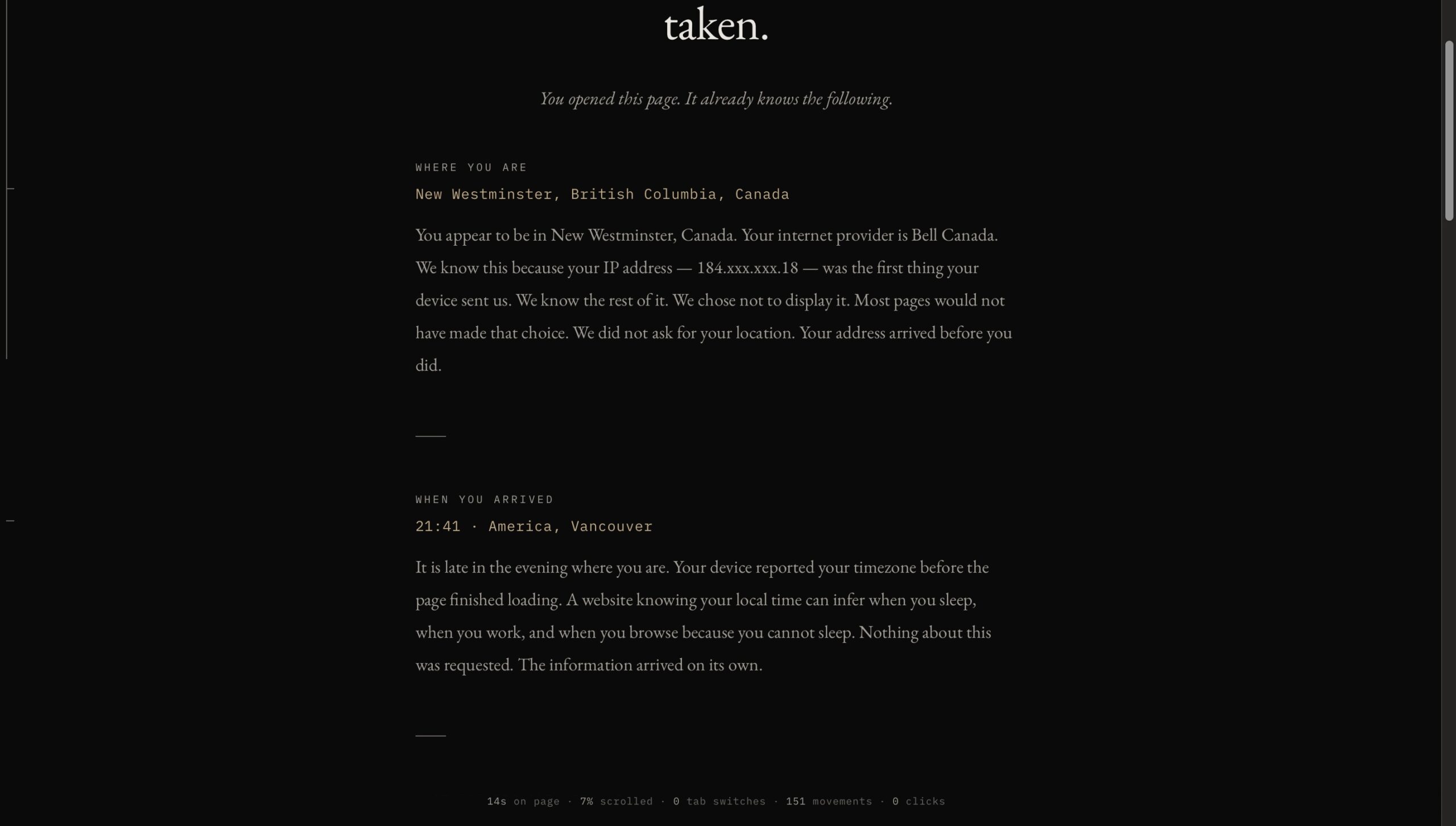
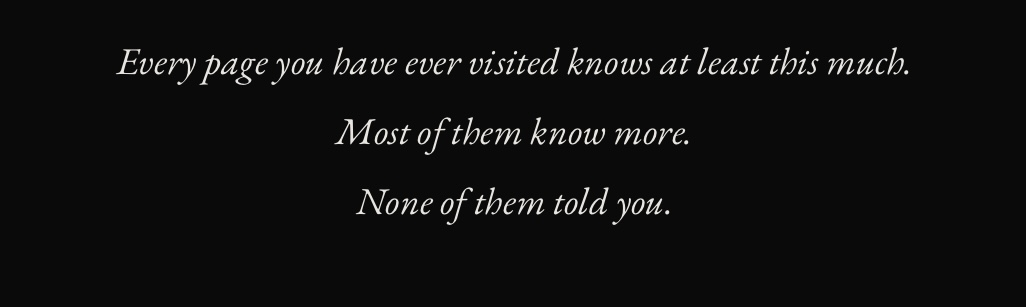
The second website we were asked to take a look at was “Since You Arrived” . As soon as you clicked on the link there was a very ominous feel to the website and revealed way more than I knew was available to see. It was able to tell me where I was accessing the website from and gave me a parietal IP address, my time zone, what search engine I used to get to the website, the website I came from before arriving at this one, and so many more creepy things. When you scroll to the bottom there is a message that reads “Every page you have ever visited knows at least this much. Most of them know more. None of them told you.” This is a scary message and not something I never gave much thought to until now. 

Screenshot

Screenshot

The next website we looked at was “Privacy.net. I wasn’t able to look into too much of the website just due to time constraints in class but after I did go back and get a better idea of what the site purpose was. Privacy.net was very similar to the last website being that it was able to tell me my IP address and give me more details on what could be accessed and how hackers or people trying to get my information could easily access certain information. Something I noticed when accessing this website for the second time was during my break on a work computer. I clicked the link and it looked different. My IP address was now showing as a location in Alberta. I got curious so I asked our IT department. They said they have technology that blocks/edits the IP address to make sure the browser is extra secure due to the confidential information we have in our system. 

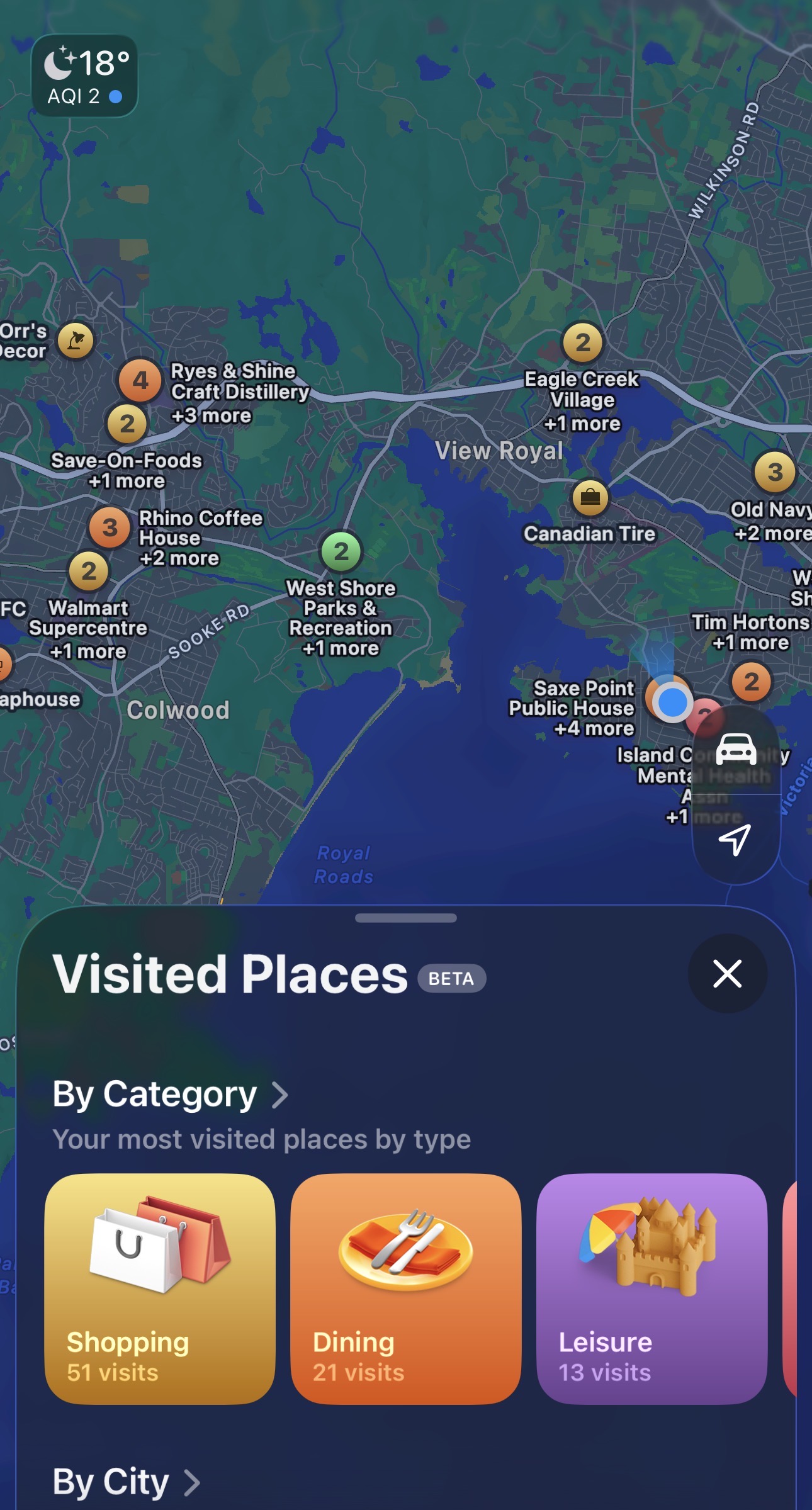
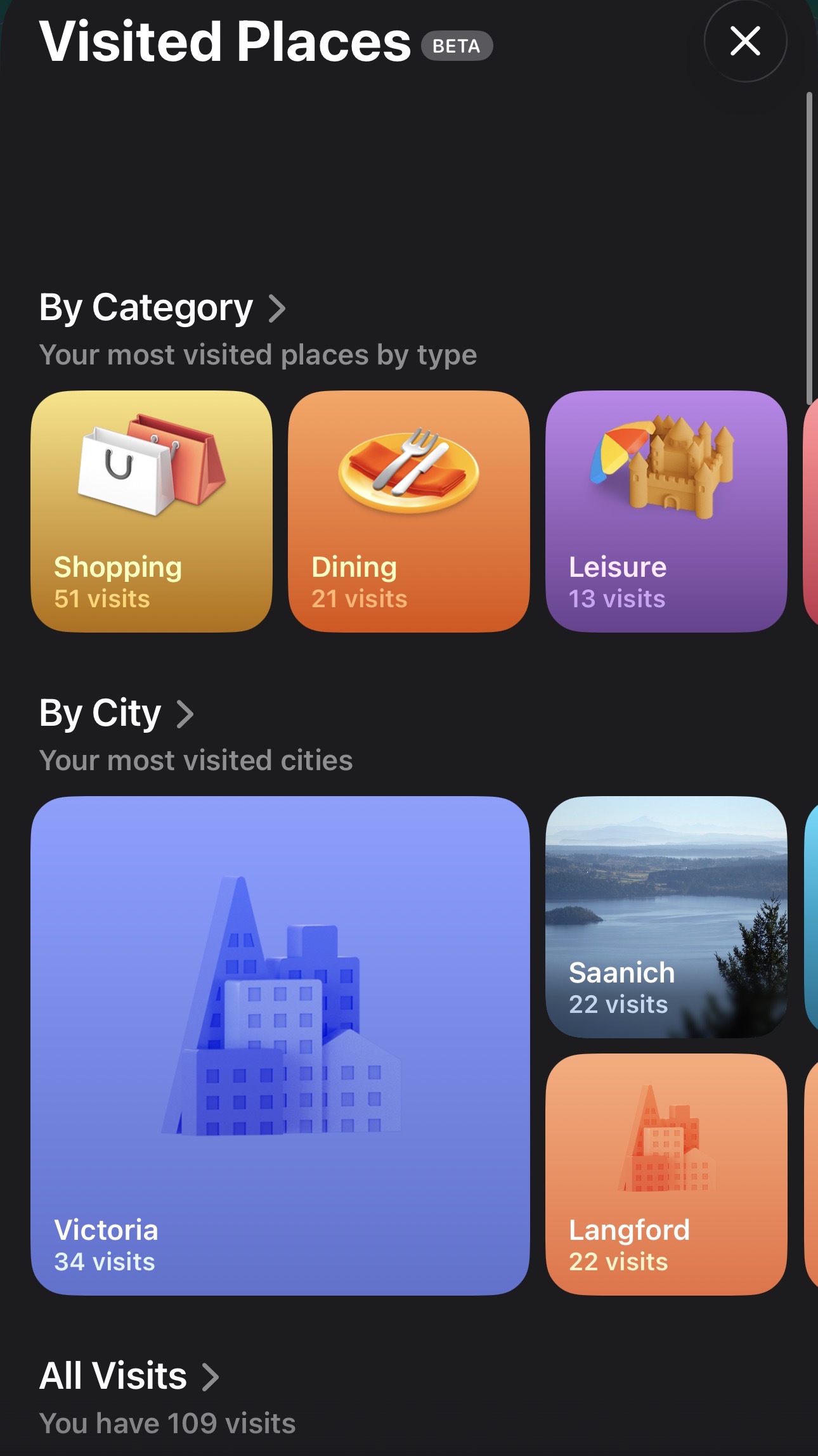
The last task we had was to go to google maps and look at our timeline. I am not the biggest fan of google maps and more used my iphone maps. I was curious to see if the app had something similar to Google’s platform. I went to the maps app and lo and behold they do. When you click on your icon it will give you a list of options. There was a tab for “Places” and when I clicked on it I listed all the locations I have visited and went back as far as February. It was grouping the location I had been to by categories such as municipalities in the Greater Victoria Area, shopping locations, dining, leisure, health, and so many more. It also showed a map view of all the locations I had been to in the last 3 months. I also noticed that it had a saved location to the place that I worked. I realized this was the case because in my calendar I linked my work location because I requested my phone to remind me 30 minutes before my shift starts and that is prompted by setting a location for the calendar event.

Screenshot

Screenshot

If I am going to be honest this week was a scary one. I had no clue these were things that my devices were capable of. My ignorance was bliss until this website opened my eyes to the things happening behind the scenes when I go to a website or use a simple app like Maps.  I have been able to secure my browser more and started to do more learning on how to protect myself when using the internet.


« Older posts

© 2026 Hana’s Blog

Theme by Anders NorenUp ↑