To start this week I wanted to get to know more about digital distractions and how social media can impact my attention span. While last week we started researching these topics I wanted to test them myself and be more conscious about my own habits.
To get a better sense of my own habits I utilised my phone apps such as Apple’s Screen Time feature to track my usage of my phone for the week. I kept a mindful eye on my screen time throughout the week and the apps u used most. One thing that I learned is that not only does it track my screen time, it also tracks how many times I picked up my phone and what app I opened as soon as my phone was picked up, as well as the notifications and how many each app gave me that week.
As part of my inquiry I tested different working conditions when completing our course work. During my phone I kept my phone beside me with my ringer on and other times I would work while my phone was in another room with a focus or Do not Disturb (DND) mode on. I noticed when my phone was out of sight I was able to focus more and felt less tempted to take a break and scroll. This was similar to research I looked at by Stothart, Mitchum, and Yehnert (2015), who found even getting or seeing a notification pop up on your screen can reduce a person’s attention and negatively impact how the task is completed. Even though I tried to be super strict with myself when doing the work, just knowing my phone was within reaching distance made it harder to concentrate on my work.
One thing I really struggle with is completing tasks due to having ADHD. When my phone is close to me I realized I was constantly switching between my course work, texts, social media and other apps. When I put my DND on and in the other room I found it easier to focus. This reminded me of a reading I did from Gazzaley and Rosen’s (2016) discussion from The Distracted Mind, and how they explained that our brains are not supposed to or are designed to constantly multitask. Their research shows that frequent notification interruptions reduce concentration and productivity. Another study I also took a look at for this week was by Rosen, Carrier, and Cheever (2013), who found that students that switch between studying and social media and that social media use was most used were associated with lower academic performance.
This week I kept track using a journal entry system as well as a weekly review which you can see below.
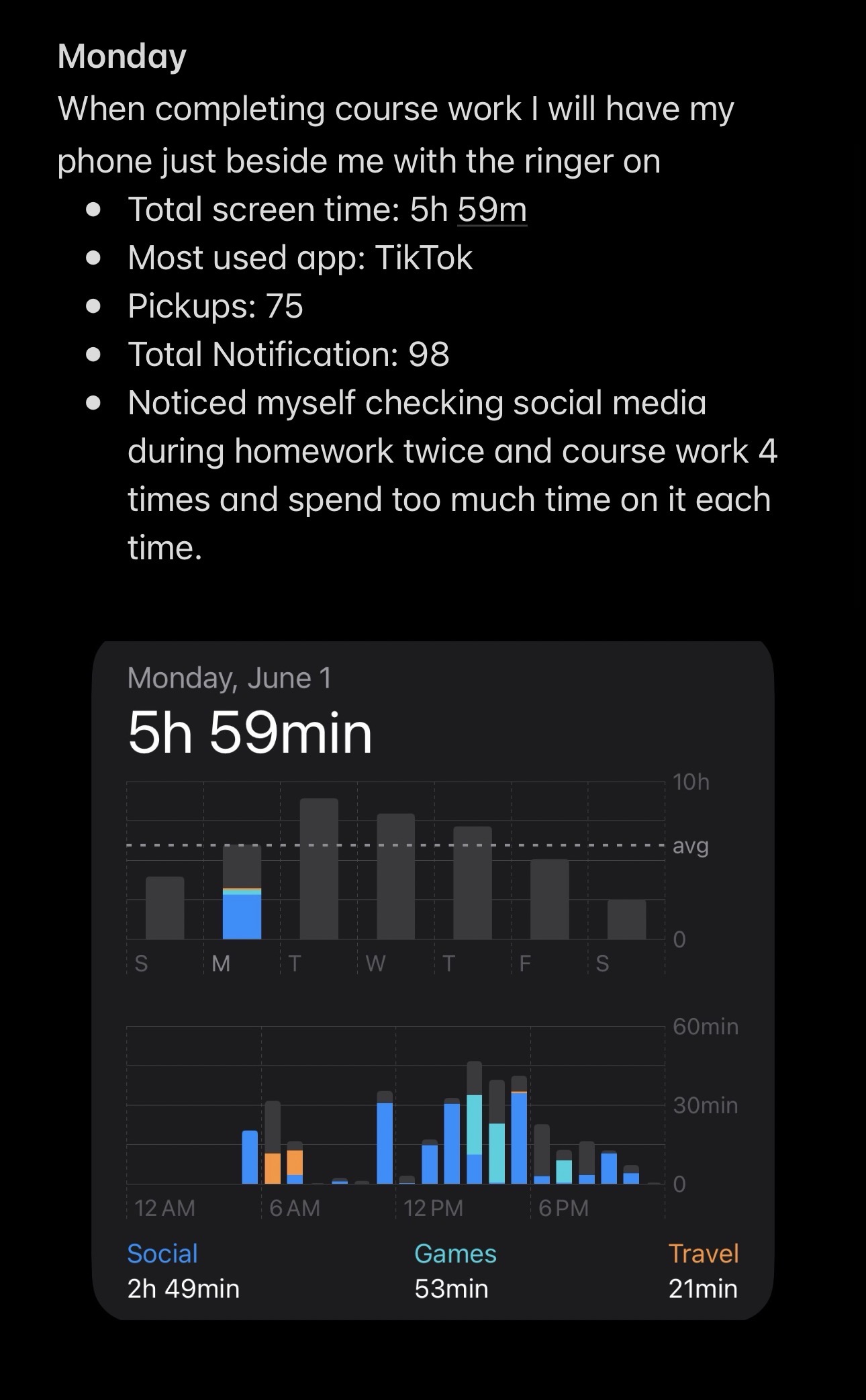
Screenshot
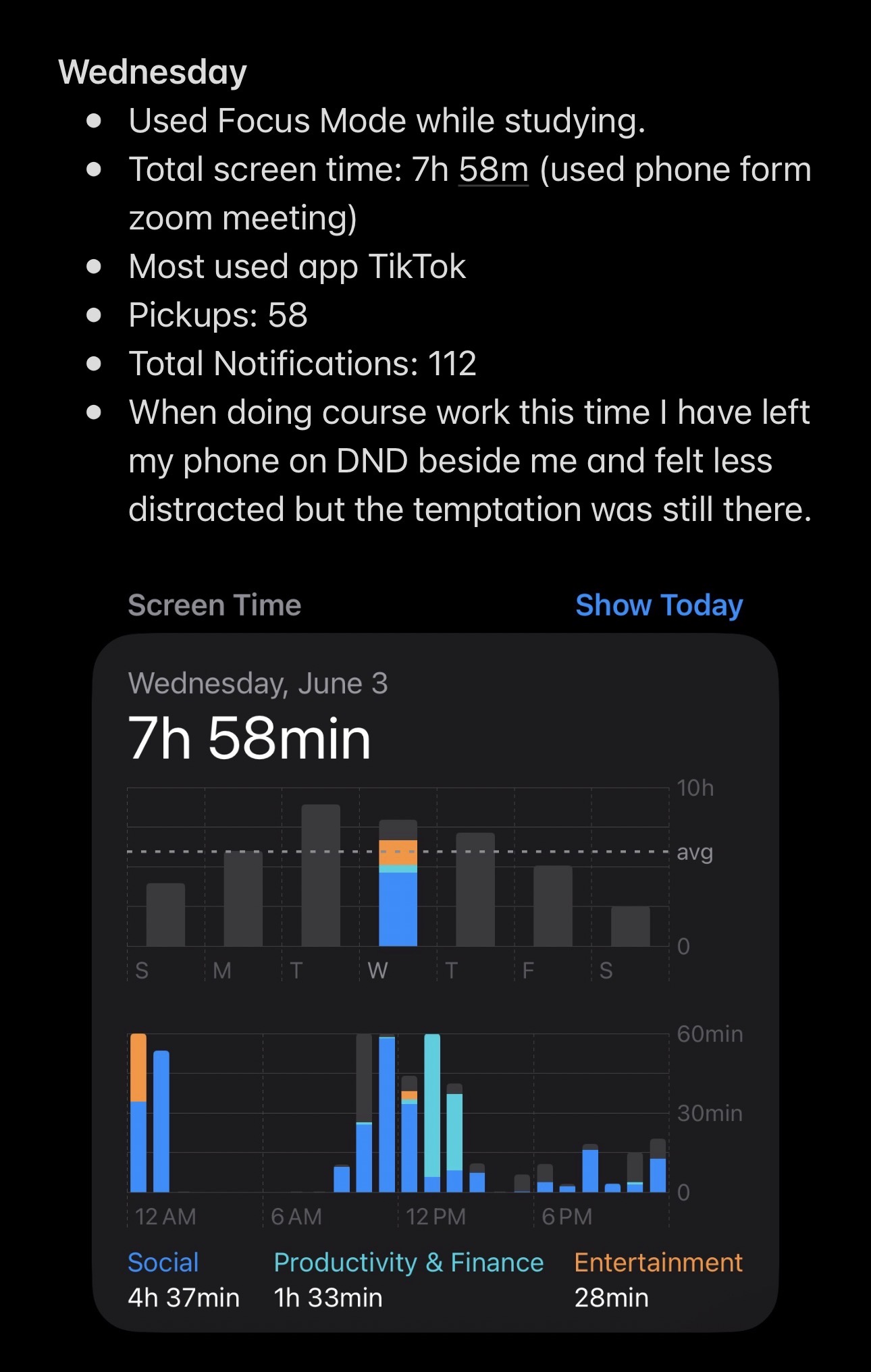
Screenshot
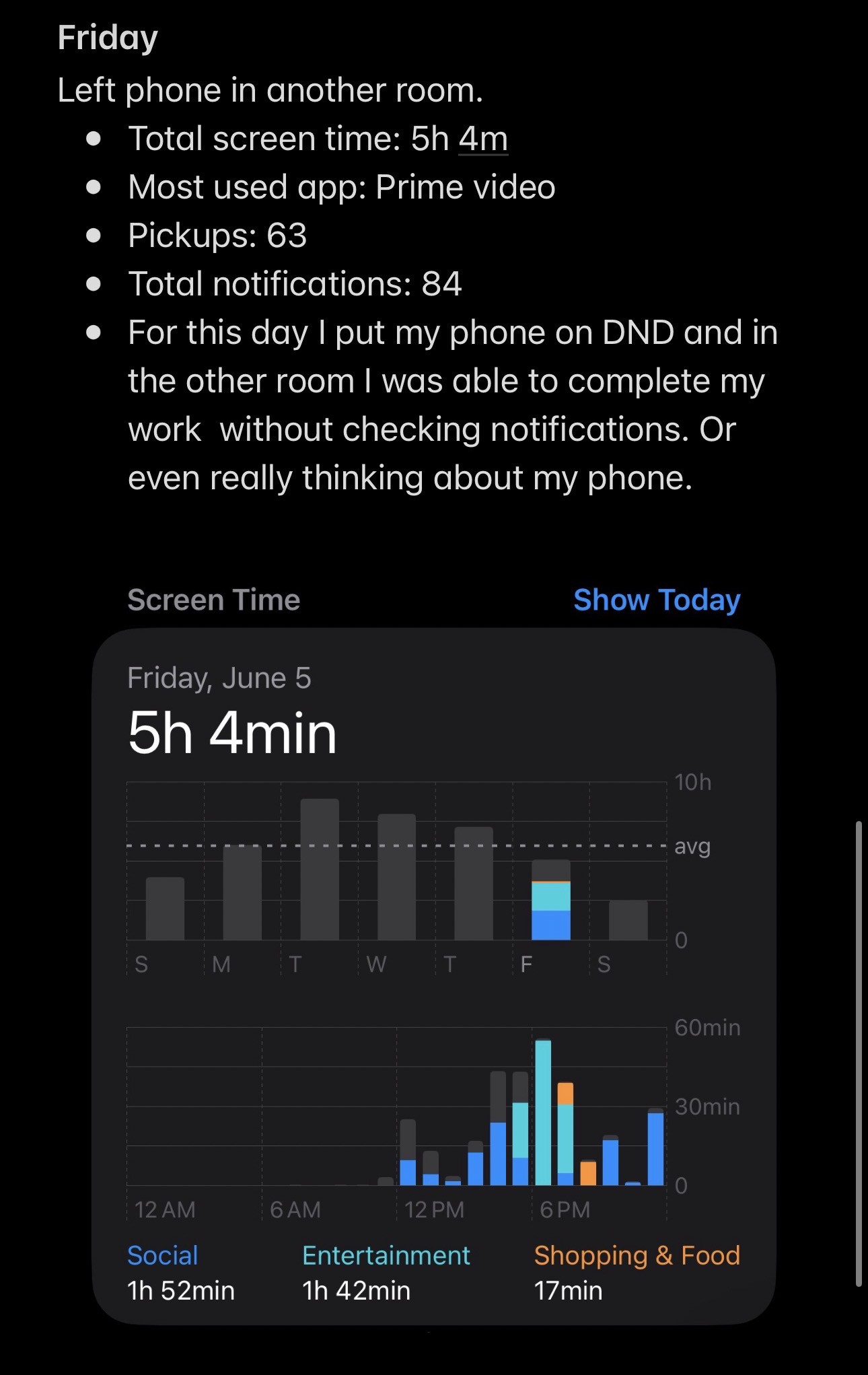
Screenshot
Weekly Review Entry
| Category | Reflection |
| Weekly Screen Time | 41h and 37m |
| Top 3 Most Used Apps | TikTok -> Instagram -> zoom |
| Educational Topics Viewed | BC road laws, sciences, history, and news |
| New Things Learned | ICBC Corporation bylaws |
| Fact Checked | Yes / no |
| Focus Rating | 8/10 |
| Productivity Rating | 8/10 |
| Biggest Distraction | Phone or environment when I did course work |
| Main take away(s) | Need to prioritize putting the devices on DND and away from my reach to keep me productive. |
Resources
Gazzaley, A., & Rosen, L. D. (2016). The distracted mind : ancient brains in a high-tech world. The MIT Press.
Rosen, L. D., Mark Carrier, L., & Cheever, N. A. (2013). Facebook and texting made me do it: Media-induced task-switching while studying. Computers in Human Behavior, 29(3), 948–958. https://doi.org/10.1016/j.chb.2012.12.001
Stothart, C., Mitchum, A., & Yehnert, C. (2015). The Attentional Cost of Receiving a Cell Phone Notification. Journal of Experimental Psychology. Human Perception and Performance, 41(4), 893–897. https://doi.org/10.1037/xhp0000100