For our inquiry project, our learning pod is working on understanding the impact of social media on our attention spans. How does social media usage affect productivity, focus, and learning in digital environments?
For my first process post I will be diving into research, consulting course content that could be applicable and reflecting on our own social media and online habits.
At the starting of our inquiry project, our learning pod created a google document where we listed out the tasks to be accomplished and delegated them among the learning pod.
This week’s tasks included:
- Gathering research/stats that discuss the social media use in teenagers and its impacts
- Looking into Australia ban on social media usage for teenagers and the impacts of the ban.
- Looking through the course content to find research on how social media is used in education and learning
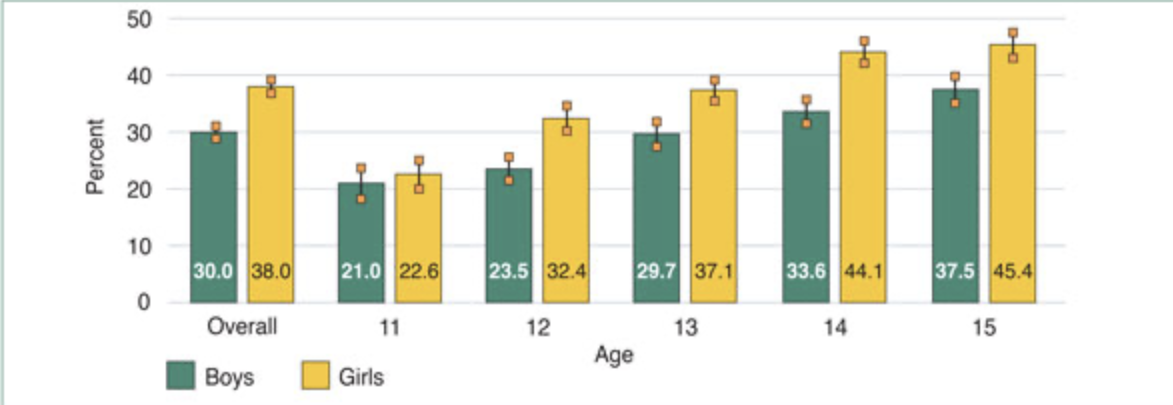
Before I jumped into the research I wanted to get an understanding on social media use in youth. One source I found was by the Public Health Agency of Canada (2022), where they completed a survey of over 17,000 youth that found that 3 in 10 boys and 4 in girls ages 11-15 used social media extensively (seen in figure below). This usage is not just scrolling for hours, but is being used as a tool to connect with classmates, family, and friends.
Figure 1
Percentage of students who reported extensive social media use by age and gender
Additional research I looked at was a review completed by Santos et al, (2023) who analyzed 50 articles that looked at potential connections between adolescents mental health impacts and screen time. When observing the data in conclusion they found that prolonged screen use showed greater impact negatively on mental health especially on younger females (Santos et al., 2023). They also touch on how different languages should be adopted, and the term “screen time” does not accurately reflect what their target research is and how that term is broad. There is a major difference between a cell phone for personal use and a computer in an educational context.
When thinking about the negative effects social media can have, many examples could be used. One of the more relevant topics that comes to mind would be legislation that was put into place in Australia. The Australian government banned social media usage for youth under the age of 16 due to concerns of mental health effects, online hate and potential predator factors (Fardouly, 2025). When we think of all the ways social media is used these can be factors, but what about how we access other content? Educational content through personal learning and school use websites like Youtube that were a part of a ban. Where even in my personal learning at that age, I was asked to use these websites to view Ted Talks. An article published by Prendergast and Dyer (2026) talks about this exactly. They looked at how tension can occur when media coverage highlights the ban while simultaneously taking away children’s access to social media and the impacts that could have. They found at the end of their analysis that while the goal of law makers was to protect youth at the same time they are incorrectly generalizing young people and the way they use social media (Pendergast & Dryer, 2026). After this a question I have is maybe banning social media is not as effective and looking into better strategies could be more beneficial such as teaching youth about internet safety.
Another aspect of the inquiry includes understanding our social media habits (that we will work collectively as a group):
- Stats: average screen time, most common app used, how many time is the phone unlocked
- Reflection: When do we tend to use social media, and does that have any significant impacts in our learning (distractions)
- Future implications: Would limiting social media use have any changes on our ability to learn better (ie. improved attention spans)
One thing that really stood out to me while researching this topic was, I found it was sometimes difficult to separate the positive and negative impacts of social media. Although many studies focus on concerns about distraction, reduced attention spans, and mental health challenges, social media usage, communication and learning for many young people.
In my personal reflection, social media is used daily, often switching between educational content and entertainment. This has made me curious about whether social media is actually reducing our ability to focus and what kind of content we are absorbing intentionally and unintentionally. We all use social media in personal and educational ways and have a decent ratio of both.
We believe our inquiry connects well with digital learning environments, learner engagement, and self-regulated learning. As we continue our project, I am interested in exploring how learners can balance the benefits of open access to information with the challenges of distraction and maintaining focus.
Going into next week I will be looking at our own habits and tracking our personal social media use. I am hoping to track this for the remainder of the course to see whether changes to our social media use affect our productivity, concentration and overall learning experience.
Sources
Fardouly, J. (2025). Potential effects of the social media age ban in Australia for children younger than 16 years. The Lancet. Digital Health, 7(4), e235–e236. https://doi.org/10.1016/j.landig.2025.01.016
Prendergast, K., & Dyer, E. (2026). Youth social media age restrictions: examining Trans-Tasman media coverage of Australia’s social media ‘ban. Journal of Youth Studies, 1–17. https://doi.org/10.1080/13676261.2026.2626495
Public Health Agency of Canada. (2022, January 4). Social media use, connections, and relationships in Canadian adolescents: Findings from the 2018 Health Behaviour in School-aged Children (HBSC) study. Government of Canada. https://www.canada.ca/en/public-health/services/publications/science-research-data/social-media-use-connections-relationships-canadian-adolescents.html
Santos, R. M. S., Mendes, C. G., Sen Bressani, G. Y., de Alcantara Ventura, S., de Almeida Nogueira, Y. J., de Miranda, D. M., & Romano-Silva, M. A. (2023). The associations between screen time and mental health in adolescents: a systematic review. BMC Psychology, 11(1), Article 127. https://doi.org/10.1186/s40359-023-01166-7