This week we took a look at the new launch of Canada’s new AI to all initiative, and while I don’t think this is coming as a shock to anyone that AI usage is gaining more traction or being used more widely because most of the time while scrolling online 1 in every 10 posts have Ai usage in some way. Whether it is changing the way an image looks, generating a caption, or even searching up anything on google AI is there. This issue starts when these posts or sources whether it is a friend, family member or even a public figure is sharing or using them as an information hub this is when things can get scary. AI has advanced and I can see that just with the videos and photos that I continue to see. It is getting harder and harder to detect AI usage, and I even catch myself taking a better look when a video or photo seems suspicious. One example of AI amplified misinformation was back in 2025 and earlier during the summer when BC was in the peak of wildfire season. Multiple images were created using AI to make the image more shocking or dramatized, and got so bad that news outlets started reporting on the mass of AI-generated photos (, 2025). This can then influence public opinion and create emotional reactions to things that are just simply not accurate. One of our assigned readings from MediaSmarts noted that AI generated misinformation which could include Deepfakes are becoming more and more common and Canadians are being subjected more to this content on a regular basis (MediaSmarts, 2025).
BC AI wildfire photo from Capital News
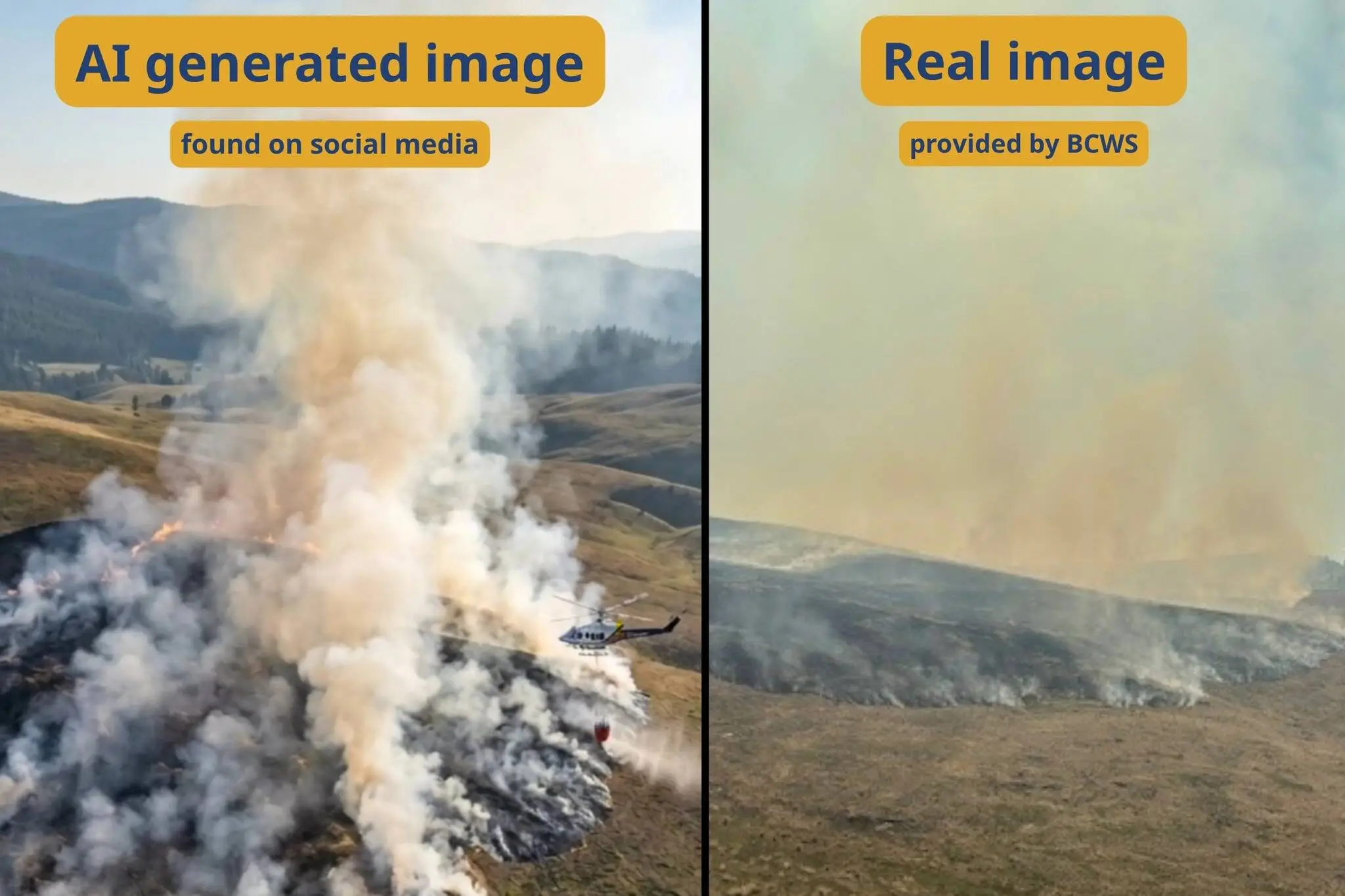
(Louis, 2026)
While researching the new AI or All initiative I stumbled upon a new bill that was introduced by the Government of Canada. It is called Bill C-34 and is a new safe social media act under the Digital Safety Act and the Digital Safety Commission of Canada Act. This act would limit regulated services that bring social media and AI chatbots to youth/children under the age of 16 years old (Government of Canada, 2026). One of the main concerns and reason why this was introduced was due to the growing amount of harmful content online and examples listed are Imamate non consensual circumstances, use of content for the purposes of bullying, content that could ensue or start violence, and more (Government Of Canada, 2026) .
Another example of an organization changing its way when it comes to AI is UVIC. UVIC has revised their Academic Integrity Policy which will be rolling out as of September 2026. On the Uvic website you can find information on the new adopted policy and here are some of my take-aways. UVIC has the understanding that AI is a reality in learning environments and gives more detail than the previous policy for when AI usage is permitted or not. One thing that I didn’t realise that the policy details was, Instructors and Professors are not allowed to use AI software to check for AI usage because these tools are unreliable and inaccurate most times (Uvic, 2026). This can connect to the bigger issues of AI literacy, and how institutions can not trust AI generated material without interventions. AI continues to become more and more integrated into our education, into the things we see on social media, and so having proper education to identify when a video is fake or real is going to become incredibly important.
Thinking about ways to address these challenges would be further education on AI content. I would look at adding it into the curriculum for students or creating a national campaign for people who are out of school and or seniors who don’t maybe have the same technology experience compared to people who have grown up around new tech. The curriculum or national campaign could help users identify key aspects or indicators that AI tends to generate and how to evaluate and verify the content is coming from a trusted source before sharing it. Rather than teaching the public to distrust or fear online content, instead find ways to build on their skills that can help them feel set up and make an informed decision.
References
Government of Canada. (2026, June 10). Government of Canada introduces legislation to make social media services and AI chatbots safer for children. https://www.canada.ca/en/canadian-heritage/news/2026/06/government-of-canada-introduces-legislation-to-make-social-media-services-and-ai-chatbots-safer-for-children.html
MediaSmarts. (2025, October 27). “Wait… What?” Media Literacy Week highlights growing concern over AI-driven misinformation. https://mediasmarts.ca/about-us/press-centre/wait-what-media-literacy-week-highlights-growing-concern-over-ai-driven-misinformation
Prime Minister of Canada. (2026, June 4). Prime Minister Carney launches AI for All: Canada’s new national artificial intelligence strategy. https://www.pm.gc.ca/en/news/news-releases/2026/06/04/prime-minister-carney-launches-ai-all-canadas-new-national-artificial
B.C. Wildfire Service issues warning of AI-generated wildfire images on social media. (2026, April 24). Kelowna Capital News. https://kelownacapnews.com/2026/04/24/b-c-wildfire-service-issues-warning-of-ai-generated-wildfire-images-on-social-media/
Hi Hana!
This is a really clear breakdown of how fast AI is showing up in our everyday lives and why that matters. I like how you point out that most people don’t even notice AI in their feeds anymore, which makes misinformation way easier to fall for, the simple ways we are forced to use it in everyday life now is often not even noticed. Your examples, like the wildfire photos, show how quickly things can get out of hand. I like the connections you make to the new Digital Safety Act and UVic’s updated policy, it helps show that institutions are trying to keep up, even if the tools aren’t perfect. Your idea about building stronger AI literacy through curriculum or national campaigns sounds good, especially for people who didn’t grow up with this technology. It’s a good reminder that the goal isn’t to scare people, but to help them be better at spotting AI‑generated content before they share it to reduce misinformation.
Thanks for sharing your thoughts!
Hi Hana! Thanks for the engaging post , I especially found your example of the AI-generated wildfire images in BC interesting. It is concerning how realistic AI-generated content has become and how easily it can influence public opinion during important events. I didn’t know that during emergencies, many people turn to social media for information, so misleading images can create confusion and unnecessary fear (B.C. Wildfire Service Issues Warning of AI-Generated Wildfire Images on Social Media, 2026).
I also found your discussion of the Safe Social Media Act very cool. Like you, I think AI literacy is becoming increasingly important, especially for the younger generations who are growing up surrounded by AI-generated content. Your idea of incorporating AI education into schools was awesome because teaching people how to evaluate sources and verify information may be more effective than simply telling them not to trust what they see online. As MediaSmarts (2025) points out, Canadians are encountering AI-generated misinformation more frequently, making these skills essential for responsible digital citizenship.
References:
B.C. Wildfire Service issues warning of AI-generated wildfire images on social media. (2026, April 24). Kelowna Capital News. https://kelownacapnews.com/2026/04/24/b-c-wildfire-service-issues-warning-of-ai-generated-wildfire-images-on-social-media/
MediaSmarts. (2025, October 27). “Wait… What?” Media Literacy Week highlights growing concern over AI-driven misinformation. https://mediasmarts.ca/about-us/press-centre/wait-what-media-literacy-week-highlights-growing-concern-over-ai-driven-misinformation