For this week’s process post and project work I wanted to shift my focus from distraction to educational opportunity on social media. While last week my group members and I looked into research I wanted to look at more research on the negative effects of social media on attention spans.
Throughout the week I intentionally followed and engaged with educational content on social media instead of aimlessly scrolling. I viewed these creators and content on TikTok, Instagram and Youtube. I look for creators who share knowledge and information on education, sciences, Law, marketing, personal development and some news accounts. One of the creators I found I enjoyed watching was Kayla Lee. Kayla Lee goes by @kaylaleelawyer on tiktok and works as a Lawyer who specializes in DUI and traffic offenses. She has extensive information and resources on ICBC and the rules and laws of the road. I have been able to keep up to date with changes to our learners permits in BC and then to fact check her information I looked into the ICBC website and viewed those changes she had mentioned. I was also consistently avoiding the short form videos and looking for longer, more in depth content in and giving thought to whether the short form videos were helping me learn new information.
One thing that makes the short-form videos or content I normally gravitate towards useful for is introducing new topics quickly. This aligns with research on microlearning, which suggests that small pieces of information can support learning and encourage further exploration of a topic (Buchem & Hamelmann, 2010). A one minute video is more just the spark notes of the subject and can sometimes not provide all the information I need on content. It feels like it can be over simplifying the content I am engaging with. It makes me think about how much meaningful learning I am getting when I am only viewing the shorter form videos.
One of the things I did when this was a concern was fact checking the information when I feel like I didn’t get enough details. I looked into peer reviewed articles and reliable sources. Research by Wineburg and McGrew (2019) highlights the importance of fact-checking and evaluating the credibility of online information, especially when learning through digital platforms. When doing this I found that most of the information was accurate and well supported, but in some cases important details were missing or even over exaggerated. This is highlighting the importance of critical thinking when using social media as a learning tool.
Another thing I was more aware of is the fact that scrolling on platforms like Instagram or TikTok, the topic of content I am watching changes every 30-60 seconds. While Greenhow and Lewin (2016) suggest that social media can support informal learning and knowledge sharing, I found that constantly changing topics sometimes made it difficult to retain information.Even though I learned small things here and there, I struggled to remember details later when thinking back to using screen time. This made me think that a journal entry could be a good way to track this.
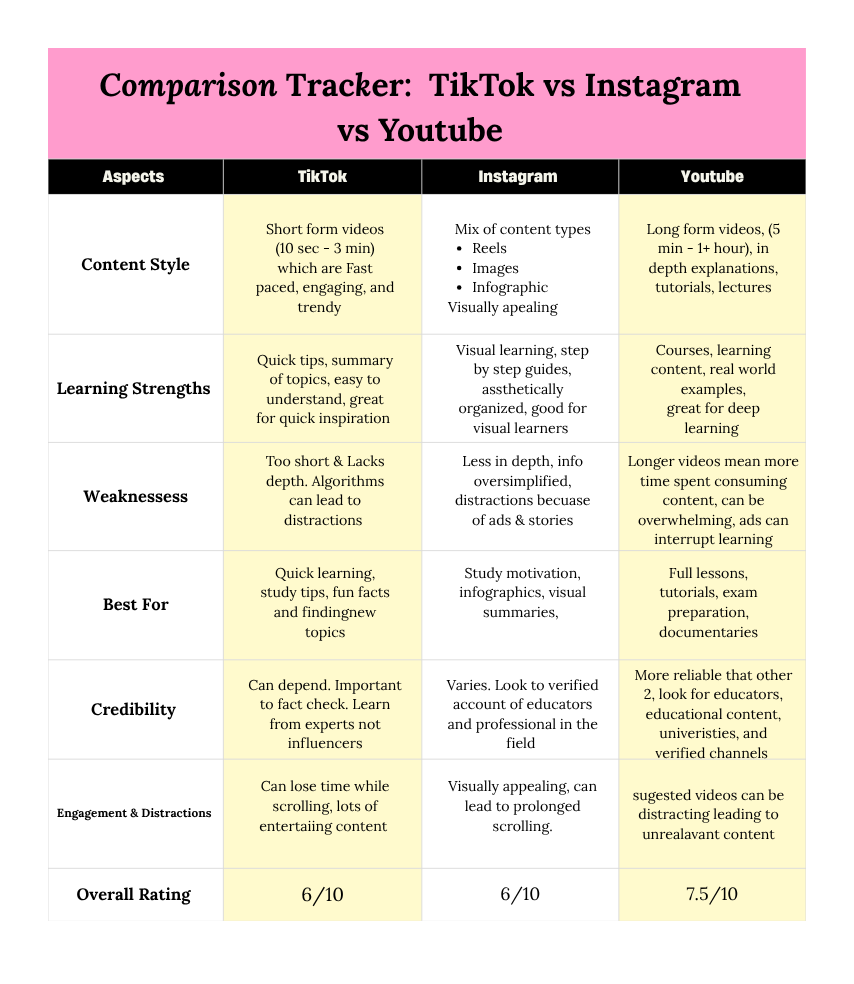
Another interesting finding was how quickly I moved from one topic to another while scrolling. Even educational content encouraged rapid consumption of information. Although I learned small pieces of information, I sometimes struggled to remember details later because I had consumed so much content in a short amount of time.
In our group project we will showcase all of our work on a website where one section is dedicated to the research we have gathered and the other section will be about our personal experiments and experiences with altering and reflecting on our social media use.
References
Buchem, I., & Hamelmann, H. (2010). Microlearning: A strategy for ongoing professional development.
Greenhow, C., & Lewin, C. (2016). Social media and education: reconceptualizing the boundaries of formal and informal learning. Learning, Media and Technology, 41(1), 6–30. https://doi.org/10.1080/17439884.2015.1064954
@kylaleelawyer
Snelson, C. (2011). YouTube across the disciplines: A review of the literature. MERLOT Journal of Online Learning and Teaching, 7(1), 159–169.
Wineburg, S., & McGrew, S. (2019). Lateral Reading and the Nature of Expertise: Reading Less and Learning More When Evaluating Digital Information. Teachers College Record (1970), 121(11), Article 110302. https://doi.org/10.1177/016146811912101102