
Figure 1. Feedback image
In our course work this week, we had a look at how teacher effective assigned grades to students. The reading we were assigned gave perspective on this as well as our class. The first thing that I thought about was the concept of how learning itself directly can’t really be measured. The learning cant really be physically observed, but how instructors and educators can make inferences about what students know based off how their work get completed or produced. To me, this is a given, but I didn’t really ever think that much about how much interpretation is involved when assigning a grade to a project. While a student could fully understand the material can experience things like stress, time pressures, lack of sleep, and make a mistake. On the opposite side of the spectrum, students might not fully understand the work but are able to get a correct answer. Vygotsky’s writing from 1978 is a contradiction to this and how grades are an accurate reflection of the learning student have.
A discussion I keep thinking about was the margins of error when it comes to grading. Guskey and Brookhart (2019) agreed that th emesuraments of grading are not allows accurate or precise and can commonly have significant margins of error. The discussion about margins of error in grading was also interesting. Guskey and Brookhart (2019) argue that grades are not precise measurements of learning and often contain a significant margin of error. The idea that many have gone over the things we talked b auto in class was how grades can fall within an average, which can have negative consequences to students needing to keep a percentage average to keep school funding, to stay in a program, or even to keep a personal goal or standard. It was a good feeling when I learned through this that receiving a 84% vs an 86% on an assignment or even a final grade doesn’t really properly represent an important different and that they are sometimes more like an estimate than and exact measurement.
One of the other concepts that stuck with me was the feedback students get. A piece from Hattie and Timperley (2007), and looked at effective feedback, finding that it helps learners understand what stage they are in their learning, where they could make some improvements, and where their writing could be with the effective feedback. Another thing that I could relate this to would be my experience as a Swimming lesson instructors and how I give evaluating and feed back to my students and their guardians. In my training and 6 years on experience in the field, I have been able to adopt ways to make sure my students from ages 2 years old all the way to 90 years are understanding where they are doing amazing and where they can improve. When talking about these areas, I use the Sandwich Method. This is where you start with positive feedback, move to an area that can improve on, then back to nothing they excelled at. This not only boosts confidence in themselves but is a way to keep a positive relationship with the water and me, especially if I have a student who is older than me, where the power dynamic is flipped.
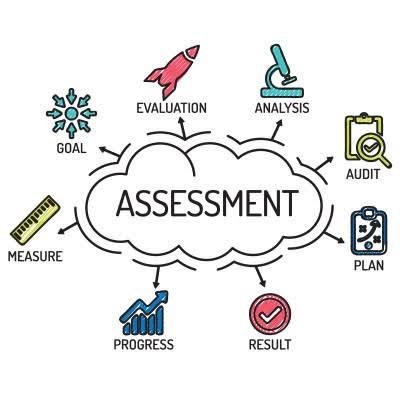
Figure 2. Assessment infographic image
Carless (2019) introduces another idea, being “feedback spirals”. This is where feedback cant be looked at as a one time thing but as something that is for learners to build on over time (Carless, 2019). I that the feedback I get from my instructors can be a little, but also can be a lot. Sometimes when the feedback is more or something that will benefit but requires me to think extra, it won’t be fixed overnight, but it is something I continue to work on going forward. Looking back at my own experiences in this, I can confirm that when an instructor has taken the time to fully evaluate my work and give me good quality feedback, I have been able to make improvement that therefore help with work in the course but also in my classes moving forward. Good feedback can go way beyond just a comment on an assignment it can improve the quality in the long run.
Another connection I learned about was technology and assessment. Bower (2019) argued that tech can work like a mediator for learning as opposed to the direct result of learning outcomes. Honestly, I think I see a resemblance to how this can apply to assessment. Technology has been able to provide individuals with so many opportunities within assessment, and some of the ones I have experience in my schooling would be online quizzes, discussion spaces, digital portfolios for an art class, and even this course. One of the main things that I can think about is when I took ASL at UVIC. The course would not have been possible at the student capacity it did if it weren’t for the videos assignment, online learning tools, and video zoom calls. I was in such an engaging and interesting course, and my grades and assessments were possible because of technology.
I am a firm believer that assessment should not simply be a way of ranking students or giving them a percentage. While I don’t know a way to make that possible or a program to execute that, all I can hope is that myself, my future teachers, instructors, and managers all have a common goal of wanting their students or employees to succeed and are will to give effective feedback all to support learning and growth that can help well into my future (Hattie & Timperley, 2007). I really enjoyed this week, and it helped me feel a little bit better about when I get a grade I’m not super happy with, because it could be 2% more.
References:
Biggs, John. 1996. “Enhancing Teaching Through Constructive Alignment.” Higher Education 32 (3): 347–64. https://doi.org/10/chx3gp.
Bower, Matt. 2019. “Technology-Mediated Learning Theory.” British Journal of Educational Technology 50 (3): 1035–48. https://doi.org/10.1111/bjet.12771.
Guskey, Thomas R., and Susan M. Brookhart, eds. 2019. What We Know about Grading: What Works, What Doesn’t, and What’s Next. ASCD.
Vygotsky, Lev S. 1978. Mind in Society. Edited by Michael Cole, Vera John-Steiner, Sylvia Scribner, and Ellen Souberman. Translated by Alexander Romanovich Luria. Harvard University Press.
Figures:
(1): Chase, C. (2020, January 20). What happens during an IT assessment? Directive Technology, Inc. https://www.directive.com/blog/what-happens-during-an-it-assessment.html
(2): Magnific. (n.d.). Positive feedback images [Image collection]. Magnific. https://www.magnific.com/free-photos-vectors/positive-feedback